


New HRI study provides critical re-assessment of reporting bias in homeopathy trials
27 мая 2026A new study by HRI, published in the Journal of Evaluation in Clinical Practice, critically examined claims made in a 2022 paper suggesting ‘shockingly poor’ scientific and ethical standards in homeopathy clinical trials1. Through this meta-research study, HRI’s re-analysis found that the earlier conclusions were based on substantially inaccurate data, which, when corrected, present a very different picture of reporting bias in homeopathy.
Reporting bias – a problem occurring in all areas of research – is an umbrella term for ways that scientific evidence can be distorted due to biased selection of which results are published. For clinical trials it can take three main forms: trials that are registered and conducted but never published, trials that are published without prior registration (publicly documenting how the study will be carried out before it begins), and trials whose primary outcome (the intended key result) is changed between registration and publication.
In the original 2022 study, to quantify rates of reporting bias in clinical trials of homeopathy, studies were identified two ways: 1) by looking for studies in clinical trial registries, and 2) by looking for published studies. The original authors then assessed if the published papers were registered, and if the registered studies were published. However, despite identifying 231 studies overall, the authors did not pool or cross-check the data retrieved from their different search strategies. This led to a dataset containing substantial inaccuracies in 39% of studies raising serious concerns about the reliability of their findings2.
These errors were corrected, then consistent eligibility criteria were applied allowing a re-analysis to be performed. Findings show that the level of reporting bias in homeopathy trials is not a cause for concern, and compares favourably with other medical disciplines:
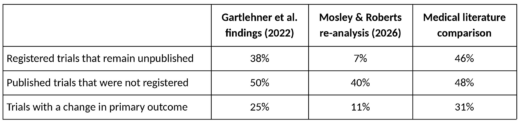
HRI’s new publication demonstrates that scientific and ethical standards in homeopathy are currently sound and that the published evidence remains valid.
References
- Mosley AJ and Roberts ER. Reporting Bias in Randomized Controlled Trials of Homeopathy: A Critical Assessment and Re-analysis of Published Work. Journal of Evaluation in Clinical Practice, 2026: e70458
- Gartlehner G et al. Assessing the magnitude of reporting bias in trials of homeopathy: a cross-sectional study and meta-analysis. BMJ Evidence-Based Medicine, 2022; 27: 345-351